
A trends study conducted by India's Financial Intelligence Unit (FIU) has expressed suspicion that cryptocurrency is being used across the country in serious criminal acts like terrorist financing, fuelling secessionist activities, cybercrime, narcotics trafficking, illegal betting and gambling. The report, which was based on suspicious transaction reports and operational analysis, shared these trends and credible intelligence with law enforcement agencies.

The court will now decide whether to accept the report or direct the agency to continue the investigation and file a chargesheet.

The Indian government has appointed Finance Secretary Tuhin Kanta Pandey as the new chairman of the Securities and Exchange Board of India (SEBI). Pandey, a 1987-batch IAS officer, will replace Madhabi Puri Buch, whose three-year tenure ends on February 28. Pandey's appointment comes at a time when the markets are experiencing bear pressure due to withdrawals by foreign institutional investors (FIIs). Pandey has extensive experience in the finance ministry, having served as the longest-serving secretary in the Department of Investment and Public Asset Management (DIPAM) and the Department of Public Enterprises (DPE). He also played a key role in the framing of the 2025-26 Budget and the drafting of the new Income Tax Bill. Pandey's appointment is for an initial period of three years.

The next Census' findings will help identify the extent of India's ageing population and vulnerability levels.

Bad loans in the peer-to-peer (P2P) lending industry more than doubled in financial year 2024 (FY24) to Rs 1,163 crore from Rs 472.1 crore in FY23, said a financial services company on Monday. Non-performing assets (NPAs), as such loans are officially called, were a modest Rs 14.7 crore at the end of FY19 when P2P lending was in its nascent stage, according to Capitalmind Financial Services that accessed data from the Reserve Bank of India (RBI) through a right to information application.

The Reserve Bank on Thursday asked banks and other financial institutions to report to the government details about accounts resembling 10 individuals who have been designated as terrorists by the Union home ministry earlier this month. On October 4, the Union Ministry of Home Affairs (MHA) had designated a total of 10 members of Hizbul Mujahideen (HM), Lashkar-e-Taiba (LeT) and other proscribed outfits as terrorists under the Unlawful Activities (Prevention) Act (UAPA). Those designated as terrorists include Habibullah Malik alias Sajid Jutt, a Pakistani national, Basit Ahmad Reshi, who hails from Jammu and Kashmir's Baramulla but is currently based in Pakistan, Imtiyaz Ahmad Kandoo alias Sajad, who hails from Jammu and Kashmir's Sopore but now lives in Pakistan, Zafar Iqbal alias Salim, who is from Poonch but presently residing in Pakistan, and Sheikh Jameel-ur-Rehman alias Sheikh Sahab, who hails from Pulwama.

In a move to strengthen governance in private sector banks and wholly-owned subsidiaries of foreign banks, the Reserve Bank of India (RBI) on Wednesday directed them to have at least two wholetime directors. Lenders that do not meet the requirement will have to submit the names for the RBI's approval within four months. Banks need prior approval from the banking regulator for the appointment of wholetime directors.

The RBI has changed the way it approached supervision in the past. Having seen a couple of collapses in the NBFC sector and the near-collapse of a few banks, it is focusing on regular drills to prevent a fire from breaking out, explains Tamal Bandyopadhyay.

The National Payments Corporation of India (NPCI) has granted approval to Paytm to onboard new UPI users, subject to the adherence to all procedural guidelines and circulars, according to the company. The move is expected to come as a relief to Paytm, which had suffered a blow following the Reserve Bank of India's restrictions earlier this year on associate company Paytm Payments Bank Limited (PPBL) in onboarding new UPI users on the Paytm app. In March, the NPCI gave approval to Paytm to participate in UPI as a Third-Party Application Provider (TPAP).

Experts say the state's economy is grappling with hidden debt, rising welfare costs, and lack of transparency.

The Reserve Bank of India (RBI) has put in place a framework to allow overseas subsidiaries and branches of Indian banks and financial institutions to undertake activities not specifically permitted in the Indian domestic market. The framework also specifies the applicability of these instructions to International Financial Services Centres in India, including Gujarat International Finance Tec-City (GIFT City). While these activities may not need prior approval, they are subject to compliance with all applicable laws/regulations and conditions stipulated by the RBI and those prescribed by the host regulator.

The Reserve Bank (RBI) resisted a 'raid' planned by some in the government to extract Rs 2-3 lakh crore from its balance sheet in 2018 to meet populist spending in run-up to general elections, Viral Acharya, who was deputy governor at RBI at that time, has written.

The Reserve Bank of India on Tuesday banned chartered accountant firm Haribhakti & Co LLP from undertaking any type of audit assignments for regulated entities for a period of two years starting April 1, 2022.

Escalating trade tensions amid a tariff war after Donald Trump took over as President of the United States (US) could adversely impact global growth and fuel inflation, an article on the "State of the Economy" in the Reserve Bank of India (RBI) monthly bulletin said.

Seasoned bureaucrat and a stickler for rules Finance Secretary Tuhin Kanta Pandey will be at the helm of capital market regulator, Securities and Exchange Board of India (SEBI), for three years. The 1987-batch Odisha-cadre Indian Administrative Service (IAS) officer, Pandey, would replace Madhabi Puri Buch, whose three-year term ends on Friday.

The RBI on Friday asked Paytm Payments Bank to stop opening new accounts amid "material supervisory concerns" observed in the bank. "Reserve Bank of India has today, in exercise of its powers, inter alia, under section 35A of the Banking Regulation Act, 1949, directed Paytm Payments Bank Ltd to stop, with immediate effect, onboarding of new customers," the central bank said in a statement. The bank has also been directed to appoint an IT audit firm to conduct a comprehensive system audit of its IT system.

The Telecom Regulatory Authority of India (Trai) may extend the deadline to whitelist URLs (Uniform Resource Locators), APKs (Android Package Kit), or OTT (Over The Top) links - through which it intends to curb their misuse -is likely to be extended by 30 days as only over 3,000 registered senders (businesses) have complied, officials indicated. According to Trai officials, over 3,000 registered senders have whitelisted more than 70,000 links, but many more (thousands of others) are yet to comply with the directive as the mandatory norms are set to come into effect from October 1.
The Reserve Bank of India (RBI), on Thursday issued orders restraining commercial transactions routed through intermediaries by a card network. The central bank, without naming the card network, said the intermediary with an arrangement with the network, did not have the authorisation to function under the Payment and Settlement Systems (PSS) Act. This led the regulator to suspend the arrangement till further notice.

One97 Communications (OCL), the company that operates brand Paytm, received a nod from the National Payments Corporation of India (NPCI) to onboard new Unified Payments Interface (UPI) users. This comes nearly nine months after the Reserve Bank of India (RBI) placed an embargo on OCL to add new customers.

The recent depreciation of the rupee along with sharp fall in the country's foreign exchange (FX) reserves has sparked a debate whether stability of the exchange rate is necessary and desirable. The rupee was one of the least volatile currencies among peers for almost two years before the current downward pressure started in September after the US Federal Reserve lowered interest rate.

Will allowing business correspondents to hawk insurance products help in reviving 5-lakh strong field agents as a viable channel?

It is only after the government's nod that a particular design change come into effect.

In the Union Budget for Financial Year 2023-24 (FY24), Finance Minister Nirmala Sitharaman had held forth on the need for better governance and investor protection in the banking sector. She had proposed certain amendments to the Reserve Bank of India Act (RBI Act), 1934; the Banking Regulation Act (BR Act), 1949; and the Banking Companies (Acquisition and Transfer of Undertakings) Act, 1970.

'With a very stable technology with limited functionalities, a large network has spanned out.'

The government can also individually exempt the PSBs, that are to be privatisated from the two Bank Nationalisation Acts. This will bring such lenders under Banking Regulation Act, and make them companies, reports Nikunj Ohri.

'The concern that the bad bank may create a moral hazard for the system is extremely valid.'

The RBI under former governor Shaktikanta Das resisted pressures to cut interest rates through 2024 as it kept its 'Arjuna's eye' trained on inflation, but the central bank under a new detail-oriented head will soon have to take a call if it can continue sacrificing growth. Das, a career bureaucrat who in 2016 oversaw Prime Minister Narendra Modi's highly disruptive demonetisation move, left a lasting legacy as he demitted office towards the end of 2024 after expertly navigating monetary policy for six years, the highlight of which was steering India's recovery through the pandemic.

The government on Wednesday said that all urban cooperative banks and multi-state cooperative banks will come under the supervision of the Reserve Bank of India, a development aimed at providing comfort to depositors and prevent repeat of PMC Bank like scams. The President of India will promulgate an ordinance to this effect, Information and Broadcasting Minister Prakash Javadekar told reporters after the meeting of the Union Cabinet.
HDFC Bank expects to amalgamate its home loan major parent HDFC into itself by September next year, a top official said on Friday. Both HDFC and HDFC Bank held general meetings on Friday to seek shareholder approvals for what is billed as the largest merger in Indian corporate history at over $40 billion. At the time of announcing the merger on April 4 this year, the entities had said the merger will take 12-18 months.

Vice President V V Giri's resignation in 1969 triggered political upheavals that saw the ruling party defy its own presidential nominee, the expulsion of a sitting prime minister by her party president, and a historic split in the Indian National Congress, recounts Utkarsh Mishra.

The decision assumes significance in the wake of a scam in the PMC Bank affecting lakhs of customers who are facing difficulties in withdrawing their money due to restrictions imposed by the Reserve Bank of India.

The RBI is fully aware that the high-cost loans and high indebtedness of the borrowers could pose financial stability risks, if not addressed by these NBFCs. Governor Shaktikanta Das has issued a stern warning, saying the RBI is closely monitoring these areas and will not hesitate to take appropriate action, if necessary, if the culprits don't opt for self-correction. Watch out for some action, soon, notes Tamal Bandyopadhyay.

The Fintech Association for Consumer Empowerment (FACE), the only self-regulatory organisation for financial technology/fintech (SRO-FT) companies, is aiming to secure membership from at least 75 per cent of players across all key fintech categories within the next three years, according to a senior executive. The total number of members in the organisation has increased to 110, up from around 60 when it received approval from the Reserve Bank of India (RBI) to operate as an SRO-FT in August.
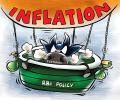
Amid a debate on the basis of a monetary policy stance, one may be curious enough to know how non-food retail inflation has behaved over the years in India. Let the eager souls catch a glimpse of facts. In the past 10 years, non-food inflation came down below 4 per cent on two occasions - pre-Covid period of 2019-20 and now in the first four months of the current financial year (FY25).

State Bank of India (SBI) is willing to work with Russian banks not facing sanctions and remain on the Society for Worldwide Interbank Financial Telecommunication (SWIFT) network to open a special rupee vostro account (SRVA) for invoicing in Indian currency. The country's largest lender in a statement said it has not been identified as the nodal bank for handling Russia-related transactions. In July, the Reserve Bank of India (RBI) allowed banks in India, including SBI, to open an SRVA to promote invoicing in Indian rupee, subject to certain safeguards. Accordingly, the bank in a statement said it is "making necessary arrangements and processing requests received from various banks, including Russian banks", following guidelines laid out by the RBI.

While the capital spending is being maintained at 3.1 per cent of the GDP, a little more would have boosted economic growth even further, suggests Rajiv Memani.

The Central Bureau of Investigation on Monday told a special court here that former ICICI Bank CEO and MD Chanda Kochhar misappropriated the lender's funds for personal use. The probe agency, represented by special public prosecutor A Limosin, made this argument while urging the special court to take cognizance of the chargesheet filed against Chanda Kochhar, her husband Deepak Kochhar and others in a case pertaining to cheating and irregularities in sanctioning of loans to Videocon Group firms. Chanda Kochhar was MD and CEO of ICICI Bank between May 2009 and January 2019 in which capacity she was entrusted with the Bank's funds, the CBI told court.

The central government is looking to strengthen the boards of public sector banks (PSBs) by specifying terms of office and conditions of service for whole-time directors, and also seeking disclosures from all directors about interests in other companies. Through the Banking Laws Amendment Bill, the government is likely to introduce conditions for disqualification of whole-time and independent directors which are not specified in the current legislation. The Centre is seeking to introduce fresh changes that are aimed at strengthening the boards of PSBs, and holding their directors accountable, an official said.

The Union Cabinet on Wednesday approved amendment to the DICGC Act to provide account holders access to up to Rs 5 lakh funds within 90 days of a bank coming under moratorium to ensure timely support to depositors. Last year, the government raised insurance cover on deposit five-folds to Rs 5 lakh to provide support to depositors of ailing lenders like Punjab and Maharashtra Co-operative (PMC) Bank. Following the collapse of PMC Bank, Yes Bank and Lakshmi Vilas Bank too came under stress, leading to restructuring by the regulator and the government.

'If the US stagnates and falls into a recession, the dollar will weaken, oil prices will also dip. This augurs well for India.'
